Wednesday, August 04, 2021

What Unites Us: Reflections on Patriotism

by Dan Rather & Elliot Kirschner

Hennepin County Library paperback 284 pages

Published: 2017

Genre: Non-fiction, history, government, society


Sadly, I didn't get to finish reading this before needing to return it to the library. There's a waiting list (and I had waited a while to get it after requesting it . . . ) but my time management skills are not at their peak.


One of the things I loved about this book was Rather's general attitude and approach. After observing this:


For I have seen how a nation can pick itself up and make progress, even at divisive and dysfunctional political moments like the present when we seem to be spinning backward.


he next makes this statement:


I have found that the vast majority of men, women, and children I have met over the course of my life are kind and well intentioned.


Rather has seen a lot of this country and a lot of human activity. I love that he can come away from it all believing this about people.


The entire chapter on Dissent (starting on page 35) is incredibly powerful. I thought about scanning it and keeping it.


This would be an amazing discussion book. I'm sure that some would see him as too left-leaning, but he makes some very worthwhile observations and raises some legitimate questions about America and patriotism (which is not the same as nationalism!).


I may need to request this again to finish reading it . . . 


(The above was written 8/4/2021. I'm adding the below on 9/7/2021.)


Scott County Library - 270 pages ( Due to font differences? Or did the version from Hennepin County have more material? Curious.)


This book is amazing. There were so many thoughts and expressions that really resonated with me that I didn't even use post-it notes. I just enjoyed it and thought about buying my own copy. What an incredible man! I love how he (and his co-author) mixed stories from his childhood and young adult life with the content he was writing about. 


The book has these sections and chapters:

What Is Patriotism?

Freedom (The Vote / Dissent / The Press)

Community (Inclusion / Empathy / Immigration)

Exploration (Science / Books / The Arts)

Responsibility (The Environment / Public Education / Service)

Character (Audacity / Steady / Courage)


Some of this book was very educational for me! On page 58 of the section on The Press, he wrote

"None of us could have predicted how technological and regulatory changes would usher in a new media landscape that, building on the Nixon legacy, would transform the very nature of news. In 1987, under President Ronald Reagan, the Federal Communications Commission (FCC) abolished the Fairness Doctrine. In place since 1949, it had stipulated equal airtime for differing points of view. In this environment where media outlets felt less compelled to present balanced political debate, AM radio stations in particular started to switch to a lucrative form of programming best exemplified by Rush Limbaugh - right-wing talk radio. For hours on end, Limbaugh, and others who followed his lead, would present their view of the world without rebuttal, fact-checking, or any of the other standards in place at most journalistic outlets.


Later, Rather writes in the chapter on Science:


So how did we get to a juncture in our history where we are rallying, marching, and lobbying to defend science against the forces of misinformation, greed, and narrow self-interest? There are many factors contributing to our current crisis: the political divide, a general loss of faith in experts and authority, and suspicion of corporations . . . Science has also had some self-inflicted wounds. We have been told that chemicals like DDT were safe, we have seen unethical research like the Tuskegee Study exposed, and we are confused by shifting directives from scientists on our own health (Is fat in our diet bad or good?).


Although Rather definitely skews liberal (IMO), he is intelligent, articulate, and thoughtful. He doesn't denigrate people he disagrees with. He's been around a long time and has seen a lot of life. This book is wonderful. I thought about trying to list my three favorite chapters, but that's tough. My favorites from each section were The Vote, Immigration, Books, Service, and Steady.


Tuesday, August 03, 2021

Look Both Ways: A Tale Told in Ten Blocks

by Jason Reynolds

Hennepin County Library hardcover 188 pages

Published: 2019

Genre: YA realistic fiction


I don't remember where I read a recommendation for this book, but I really like Reynolds' writing style. This was a series of short stories that had characters and themes interwoven. It was beautifully written! The flying school bus had me curious up until the last story. Most of the stories were bittersweet and even heart breaking . . . but there was plenty of light in them as well.


From the first story about the "Low Cuts" (little hooligans) and why they wanted money so much to the "broom dog" that helped Canton through his mom's accident, this book is powerful.


One section where the language captivated me was in the story "Satchmo's Master Plan." "But no matter what his mother said, no matter what she taught him, it didn't matter. Fear had clamped down on his brain and the scars on the back of his leg - the raised dots and dashes like Morse code on his skin - served as a reminder that dogs were dangerous." 


Reynolds is such a good writer!

Thursday, July 29, 2021

A Piece of the Moon

by Chris Fabry

Dakota County Library paperback 360 pages

Published: 2021

Genre: Christian realistic fiction / "historical" - 1980s


This was our book club title for July and I loved it! I know we've read one other Chris Fabry book, but I seriously need to get more of his stuff! His writing style is great! It felt like you got to know the characters and could care about their lives. It took place at a country radio station in West Virginia.


*** Spoilers ahead. If you haven't read the book, do!***


As soon as I read the premise of millionaire Gideon Quidley hiding a treasure and leaving clues via Bible verses, I thought of Forrest Fenn and the recent discovery of his treasure in the Rockies. It made this story that much more believable and made me curious to do some extra reading on Fenn.


Page 32 - "Even though he would arrive home dog-tired from work at the plant, cars kept coming and he'd tinker all hours of the day and night. He didn't charge, which was a hardship to his family, but there is no gift to the world like a man doing what he enjoys."


In this passage referring to Pidge's dad, I saw the truth and beauty in that last line. Work isn't work if you love doing it.


Page 67 - "A timer could help you get out of the way of the first vocal, but it couldn't bring the magic. And it seemed like the world was becoming less about magic and more about timers every day."


There was a lot of radio-specific content in the book, but Fabry wrote it in a way that made it accessible and even interesting. I think we all know what dead air time sounds like (or get frustrated with DJs who talk over singers) and this "magic" is what Waite is about. He's old-school and values the smoothness that comes with listening and practicing good timing.


Page 82-82 Waite teaching Wally about value using a $20 bill. This is so good! Start midway down the left hand page with "It's more than a streak," . . . this book is so good! I loved Waite and his compassion for others! I loved the theme of second chances and reconciliation.


Page 170 - "That which is foreign is often feared, especially when it comes to prayer."

I'm not sure what about this most caught my attention. It's interesting how something different (an idea, a culture, food, etc.) can make people fearful.

Page 207 - "The nurses tried to stop it. They were all out of sorts. Milton Quidley pulled the plug on his daddy. Gideon died an hour ago."

I couldn't believe it. No matter how selfish and petty you are, to end your parent's life so the will can be read . . . isn't that murder?

Page 223 - "The call made him feel warm inside. Growing up, all he'd heard was how bad and stupid he was. And that was from someone supposed to love him. Waite lived differently."

Clay was such a delightful character! I loved how he was able to keep Jubal from Milton by telling him how to treat her fleas (which she didn't have). I loved that he recognized that Waite was special. And I loved when he courageously went on-air to convince people that the dam was ready to break and they needed to evacuate. 

Page 243 - "The Kid listened from the front of the boat and didn't speak. And it struck Waite that the most powerful thing you could do was listen."

The personal growth in Clay (The Kid) also reflects a growth in Waite. I loved these interactions! And I loved Clay reaching out to Waite's adult estranged daughter. 

Page 252 - "Every dang time he'd work in a verse or two about the heavens declaring the glory of God or some such. I'd tell him to keep his religion to himself. But if you really believe you got an answer to life's problems and you don't tell nobody, what good is the answer? So I don't fault him."
 
When TD goes to talk to Corky about Gideon Quidley and the treasure, their conversation gives us more insight into the eccentric millionaire and his desire to share God's Word with people. I like TD's story arc quite a bit.
 
Page  258 - "He rode away thinking libraries were filled with smart people who could find anything."

Clay again. And me liking his observation! I'm a bit biased about librarians, though. 

Page 326 - "Laughter is like water to a dry pump. A little will prime it and pretty soon you have all you need and then some."

When Pidge is thinking this about Clay, it made me think of the positive impact his presence had in her life, Waite's, TD's . . . and his own. This was just a really, really fantastic story! And I loved what happened to the wealth, too.


Of Mutts and Men

by Spencer Quinn

Scott County Library eBook (Libby)

Published: 2020

Genre: Murder mystery


From Goodreads: 

When Chet the dog, "the most lovable narrator in all of crime fiction" (Boston Globe), and his partner, PI Bernie Little of the desert-based Little Detective Agency, arrive to a meeting with hydrologist Wendell Nero, they are in for a shocking sight--Wendell has come to a violent and mysterious end. What did the hydrologist want to see them about? Is his death a random robbery, or something more? Chet and Bernie, working for nothing more than an eight-pack of Slim Jims, are on the case.

Bernie might be the only one who thinks the police have arrested the wrong man, including the perp's own defense attorney. Chet and Bernie begin to look into Wendell's work, a search that leads to a struggling winemaker who has received an offer he can't refuse. Meanwhile, Chet is smelling water where there is no water, and soon Chet and Bernie are in danger like never before.


I read this quickly and moved on to request the most recent (2021) release . . . 


One of my favorites in this book was the little girl. I've already returned the ebook and I can't recall her name. Lindy? Anyhow, she rocked! Glancing through reviews on Goodreads, I think Quinn's writing style either tickles your fancy or it doesn't. I love the story from the dog's point of view. 

Chet and Bernie

I love this series and get tired of googling it to figure out titles. No bells & whistles, just the titles (from Goodreads, Amazon, etc.) I haven't read any of the e-short titles yet.


#.1 - A Cat Was Involved (e-short) / 2012

#.3 - Tail of Vengeance (e-short) / 2014

#1 - Dog On It / 2009

#2 - Thereby Hangs a Tail / 2009

#3 - To Fetch a Thief / 2010

#3.1 - Santa 365 (e-short) / 2015

#4 - The Dog Who Knew Too Much / 2011

#5 - A Fistful of Collars / 2012

#5.1 - The Iggy Chronicles, Vol. 1 (e-short) / 2013

#6 - The Sound and the Furry / 2013

#7 - Paw and Order / 2014

#8 - Scents and Sensibility / 2015

#9 - Heart of Barkness / 2019

#10 - Of Mutts and Men / 2020

#11 - Tender Is the Bite / 2021

#12 - It's a Wonderful Woof / 2021?


Heart of Barkness

by Spencer Quinn

Scott County Library eBook (Libby)

Published: 2019

Book #9 in Chet and Bernie Mysteries

Genre: Murder Mystery


I read this a few weeks ago, but kept forgetting to blog it. It was my first time reading on Libby, Scott County's new eReader. I really enjoyed having the book on my phone!


In this one, Bernie's neighbors the Parsons have gotten a saguaro cactus from their son who was recently released from jail. Soon a conservation officer shows up to charge them with a crime. As Bernie and Chet look into the mystery, one body after another shows up. Shooter (who is clearly Chet's progeny) plays a key role in this tale. 


I love Chet! I don't like when people try to hurt him. I love that the good guys win in the end. These books are addicting and I quickly ordered and read the next title in a weekend at the lake.


Tuesday, July 20, 2021

The Long Way Home

by Louise Penny

Hennepin County Library audiobook 10 CDs

Published: 2014

read by: Ralph Cosham

Genre: murder mystery


Ann has recently discovered Penny's Inspector Gamache. I hadn't read one in a while, so I got this. I quickly remembered what I like (detail, clues, etc.) and what I dislike (overdramatized, overwrought characters).


Since I was listening to an audiobook, I just have quick jotted notes.

  • When listening to the audio, the shifts between scenes and characters in a chapter is disconcerting. I'm pretty sure on the page, you can see a gap. But the reader goes directly from Myrna and Clara to Gamache and Bouvoir . . . and it bugs me.
  • The St. Lawrence River and a meteor impact you can see from space?! I had to Google it. https://en.wikipedia.org/wiki/Charlevoix_crater    Fascinating!
  •  Asbestos . . . lots of interesting stuff here, but I was surprised at how clueless they were while learning about it.
  • "fine line between privacy and secrecy" - yep. 
  • The Tenth Muse . . . overdone and overwrought.
  • Norman / No Man 
  • Captain's vs. admiral's cabins on the ship . . . why did this bug me? Why did Myrna and Clara stay silent so long?
  • symbolism . . . and lots of it.
  • Duh! Massey! Killer chase . . . seriously. How did they not consider this? Asbestos-covered canvases and who's trying to kill whom? 

I think I need to read other authors. For some reason, Penny just bugs me. (Or maybe I'd like the print books better?) I think Miss Marple is my favorite detective.


Becoming Bulletproof: Protect Yourself, Read People, Influence Situations, Live Fearlessly

by Evy Poumpouras

Hennepin County Library hardcover 299 pages

Published: 2020

Genre: Non-fiction advice


This was a really interesting book by a fascinating woman. Former Secret Service Agent Evy Poumpouras could probably have just written a memoir and had my attention. The self-help aspects were a little less intriguing for me. This woman has already had such an interesting life and she's still pretty young! (And gorgeous - her author pic is impressive.)


I put a lot of post-it notes in here, but it's been over a week since I finished the book . . . not my best mode for blogging, but I definitely enjoyed reading this.


Page 7 - Right away in the prologue, she's relating her experience in NYC on 9/11. Wow! This was a powerful way to start her story.


I prayed in Greek, as I'd been taught growing up in the Greek Orthodox Church. I kept my eyes open as the world around me split apart. I wanted to see death coming for me. I knew I had no choice in my death, but I could choose how I faced it. Even when I could no longer hear the sound of my own voice, even when my face and mouth filled with dust and ash, I kept my eyes open and prayed. As the tower collapsed above me, strange as it might sound, I felt a peculiar peace spreading through me.


Not peculiar at all! That's God in action, Evy. You should pray more, not just when you think you're going to die.


Page 11 (still prologue) - I like how she noticed the actions of others who were not first responders.


They helped because it was the only thing they could do. Because, without being told, they already knew that when it seems like the world is ending, being willing to help others is the antidote to fear.


I believe that most people prefer to do the right thing. I love seeing / hearing about people being kind, compassionate, helpful. 


Page 14 - In direct contrast to that last note . . . 


Fast-forward to today and we find ourselves facing new fears. Mass shootings, school shootings, and cyberattacks filter into our social media and news feeds. The world feels full of fear in a way that can immobilize and overwhelm us at a moment's notice.


Is there more fear or just more fear-mongering? As people want to exclude God and faith from their lives, are they just reaping what they've sown? I can't imagine how stressed I'd be without faith in Jesus and the power of God's Word. No thanks.


Page 36 - I really liked how she shared about her childhood and how that shaped her attitudes and career choices. This quotation sums up part of her life philosophy (in my mind).


I know fear keeps us alive, but I also know that fear can keep us from living.


She had also talked about our Fight, Flight, or Freeze responses. This is a really interesting book. She uses a lot of F-bombs, though.


Page 60-61. I decided to take a photo of this two-page spread. These are good questions to ask yourself. It's so easy to get sucked in to other people's "stuff." 

 
Page 72 - This really hit home. It has come up a lot in our book club discussions in the context of God using our pain as a way for us to minister to others who are suffering. The author has a secular take on that idea.
 
When we can find meaning in our personal tragedies and use them as a way to enhance our lives, or the lives of others, we'll emerge stronger and more resilient. 
 
There was more, but I'm already tired of blogging on this book!
 
Page 107 - Her advice was interesting, even if I enjoyed her personal stories more.
 
Predators primarily seek out those they perceive as weak. The ones they think will go down easy, who won't put up a fight. You know why? Because they don't want a fair fight. They want someone they can conquer. They are looking for an easy target. Don't give them one.
 
 It breaks my heart when the most vulnerable people are hurt further. This advice is valuable, but it doesn't go far enough in helping people know how to be stronger. 

Page 153 - Again, interesting.

Reading body language is about becoming an investigator of behavior. The body doesn't lie. In fact, regardless of a person's agenda, the body wants to tell the truth. Sometimes, no matter how much a person tries to remain composed and controlled, the body will signal when it's lying. Professional interrogators call this bleeding information, because information will leak from the body almost like an open wound.

She goes on to talk about posture, leg movement, etc. She has had such interesting life experiences!

Page 176 - I just wrote "Trump" on the post-it. She worked detail for three other presidents, but not #45.

Over-the-top denials are intended to be so emphatic and dramatic as to eliminate any trace of doubt from your mind. But remember, the truth is simple. When someone tells the truth, they tend to tell it directly and matter-of-factly.

The example she listed at the top of this section (subtitled "Emphatic Denial") are what made me think of our last president . . . especially "I categorically deny everything you just said."

Page 185 - This line made me think of the challenges in being an effective teacher!

But did you know that most people stop listening about three minutes into a presentation because their minds wander or they get bored. It's a challenge to hold people's attention for a long period of time. This is why connecting with your audience is just as important as knowing your facts.

She's actually worked as a teacher in her post-Secret Service life, so she knows a few things. :-)
 
Page 223 - I love her answer to the question, "How do I make someone respect me?"
 
 "You can't." Respect is not something that can be forced or demanded. It's a gift. If someone wants to give it to you, they will. And if they don't, they won't. That's it. Yes, your words are your most powerful weapon. But when it comes to commanding respect, sometimes it's best to hold your silence and simply show the world who you are through what you do.

Page 242 - This was a post-it for me to check myself! It's in the section subtitled Keep Your Ego in Check. Yikes!

Have you ever been in a meeting when you could tell that the person was talking just to hear the sound of her own voice? Not only do they end up contributing nothing to the conversation, but it often ends up feeling like a waste of everyone's time. When people monopolize the conversation without adding anything of substance, it's a sign of insecurity. Don't be that person.

I think for me, it's more of a habit. I babble, whether or not I have something worthwhile to say. And I'm not a good listener. This is something I don't like about myself.

Page 254 - I loved this graphic and the description! Covid has definitely made "personal space" weirder, but this is a good way of explaining. (Another reason not to teach elementary school. They do NOT respect personal space very well!)


Page 262 - She really does have a lot of good, solid advice.


Don't let a bad five minutes in your day - a traffic incident, disagreement with a friend, anything - ruin your entire day or week. You have power in how you react to setbacks, and being able to move on is a skill worth cultivating.


Page 266 - I don't necessarily agree with her assessment of "mentoring," but she makes a good point.


These teaching points in life don't need to come only from those you consider admirable. You can learn just as much from an asshole as you can from a role model. Some people possess qualities you admire most while others show you what you should carefully avoid.


Page 281 - I love how Poumpouras closes her book by talking about the positive traits she gleaned from the men and women she worked for in the White House. They were all insightful and interesting. I marked this one about Hillary Clinton because it kind of surprised me.


Over the course of my career, I have never seen anyone take as much mistreatment as Mrs. Clinton endured in the public eye. . . . Her unwavering defiance is unlike anything I have ever known. When I am faced with ridicule, criticism, or judgment from others I think of her.


I actually checked out the author's webpage after reading the book. I'm glad I saw a review of this and chose to read it!

Thursday, July 08, 2021

Scents and Sensibility

by Spencer Quinn

a Chet and Bernie mystery (#8?)

Scott County Library audiobook 8 CDs

Published: 2015

read by Jim Frangione

genre: murder mystery


A saguaro cactus, Shooter, Mr. and Mrs. Parsons' son Billy, a crooked cop, . . . this is one of my favorite C&B stories so far. I liked that there wasn't the Susie Sanchez romance as much (though she may take a job in London . . . ). I didn't like that Chet was treated poorly by the bad guys. I loved the Shooter / Chet storyline!

Monday, June 28, 2021

The Great Earthquake and Firestorms of 1906

by Philip L. Fradkin

Hennepin County Library hardcover 349 pages plus endnotes (photos included)

Published: 2005

Genre: Non-fiction, history


I got this book after our book club read The Nature of Fragile Things. That work of historical fiction made me curious about what the 1906 San Francisco disaster was actually like. Fradkin's extensively researched and well-written novel was fascinating, but also a bit daunting. I'm giving up on page 138 out of 346 pages. There are another 72 pages of endnotes, index, etc. 


The biggest surprise to me was that they used black powder dynamite to try to create a firebreak! But of course, the explosives just set more fires and spread it faster.


It's not surprising to me that most of what we know about what happened is from upper middle class people. We have very few first person perspectives from poor people or minorities. It's also unsurprising that some engineers had been warning of the potential for disaster and were not heeded. Will we humans ever learn?


The photographs and first person letters were most powerful. I've not been to San Francisco since the 1970s, but this makes me want to go visit!

The Promised Land

by Elizabeth Musser

(Book 3 in the Swan series?)

Carver County Library hardcover large print 515 pages

Genre: Christian realistic fiction

Published: 2020


It's such a delight to get a book club title so that I can read it before book club! (We meet tonight 6/28/21.) I don't ordinarily like reading large print books, but it's better than going to discussion without having read the title. From the back cover: "When her husband of twenty years announces that he's leaving her, Abbie Jowett feels an overwhelming loss. Desperate to mend her marriage and herself, she follows her son Bobby to France to walk the famed Camino de Santiago pilgrimage."


At first, I didn't enjoy the book at all. I don't like broken marriages, I didn't like Abbie's overbearing personality, and I didn't initially connect with Bobby, Caroline, or anyone else. But I'm glad I kept reading!


I wrote down this quotation from chapter four, but am not entirely sure which character said it. "Yes, grief is so odd. It catches me at times when I expect the least of it." Grief can be odd indeed. It's weird how I'll have a thought or memory of my mom or dad and just start crying. And it's been more than a few years now!


Chapter 5 included this blurb about spiritual disciplines:

"Spiritual disciplines are all about making room for God. In our fast-paced life, it is often easier to push God into a tight schedule with the rest of our day rather than take time to truly hear Him."

This was told to Abbie by Diana, a spiritual advisor. Sometimes my practicing spiritual disciplines becomes closer to me checking items off my to-do list and less about drawing near to God. This caught my attention.


In chapter 7, I started to appreciate Abbie's life story and perspective. She is looking through a scrapbook and remembering tragedies and difficult life events. 

"I would have to figure out how to protect everyone I loved. . . . Maybe that was when I went from an ordinary perfectionist to a control freak, hypervigilant and fearful. . . . How perfectly ironic that what drove him away was me trying so hard to make sure he never left."

This was powerful, her realizing how and why her personality changed. I like to empathize with the protagonist. This chapter helped me appreciate her more.


In chapter 8, Abbie is again visiting with Diana. 

"I felt most useful in a group when I could help others come up with a plan. . . . Now I just drive everyone crazy with my planning and my control." 

It's interesting how one's strengths can also mirror one's weaknesses! 


In chapter 10, Bobby is taking on the burdens of his parents and grandparents. They don't *want* him to shoulder their issues, but he is concerned and feels as though he needs to rescue them.

"When I click off the phone, I feel the cloak covering me, smothering me with worry. I feel old. Not just like an 'old soul,' Mom and Dad's description of me, but old like all the fun and adventure and cool stuff I hoped to experience has been ripped right out of my sketch pad, wadded up, and discarded."


In chapter 11, after Bobby has spent time with Jean-Paul, who has lost the use of his hands, he realizes the blessings he enjoys. There are definitely times for us to be grateful for our many, many blessings - especially the ones we can take for granted!

"Then I pause a moment, cradling the phone in my left palm and gazing at my hands. Young hands that work - no tremor, no arthritis, no fear. And I bow my head and think, Thanks, God, for my hands."


Chapter 12 brings an observation by Abbie.

"But Miss Abigail wouldn't have called it ridiculous. She called 'coincidences' like these winks from a God who loves to remind us of His presence."

This made me think of the book Godwinks! I may need to buy a copy of that . . . 


In chapter 13, Caro is tempted to fall off the wagon as a way to cope with stress. The language that Musser used to describe this is so evocative.

"I am tempted to go to the cave and pull out three good bottles of wine and chug them down one after another until the hot sparks of hate are extinguished by the deep burgundy liquid that will kill my soul."

I like drinking wine, but have known people who struggle with alcoholism. It seems that this description is apt.


In chapter 19, Caro is reflecting on the perilous mountain situation. I love that Caro and Abbie connected. I love that Caro had her sister-in-law Tracie as a support in staying sober. I love her growth as a character in this story, though the story line with Bastien felt a bit overdone.

"But you'll be happy to hear that some things are beginning to get through my thick head. Like helping Rasa. It felt, I don't know, it felt really good. And natural. Like maybe some of the junk in my life can help me know how to help others. If that makes sense."


Chapter 21 is where I cried. And cried. Abbie's willingness to let go of those she loves most. Wow. Great book! Makes me want to read the rest of The Swan House Series.


I look forward to discussing this book with other readers.


Shouting at the Rain

by Lynda Mullaly Hunt

Scott County library hardcover 269 pages

Published 2019

Genre: YA realistic fiction


I read this a few weeks ago, but remember being slightly disappointed. Perhaps because I *so* love Hunt's first two books, my expectations were too high for this third effort. 


Here's the summary from Amazon: "Delsie loves tracking the weather--lately, though, it seems the squalls are in her own life. She's always lived with her kindhearted Grammy, but now she's looking at their life with new eyes and wishing she could have a "regular family." Delsie observes other changes in the air, too--the most painful being a friend who's outgrown her. Luckily, she has neighbors with strong shoulders to support her, and Ronan, a new friend who is caring and courageous but also troubled by the losses he's endured. As Ronan and Delsie traipse around Cape Cod on their adventures, they both learn what it means to be angry versus sad, broken versus whole, and abandoned versus loved. And that, together, they can weather any storm."


I grabbed shots of some text to blog about. Here's from page 63:


 I love her grandma's wisdom. "Don't let yourself go to the sad place for too long." I just love her words to Delsie at this time - respecting her feelings, but encouraging her to put her "arm around happiness and invite it inside." Sweet message!

Yes, the girls in the story were most definitely making this hard for Delsie. Mean girls are so challenging!


Page 64 was too blurry of a photo to include here, but the part I wanted was this:

"Well," Grammy says, "you either succeed or you learn. If it doesn't work out, you can handle it. You'll be sad, but you can handle it. That Brandy Foster won't break my girl."

I manage a smile, but all I can think about is Tressa. It's weird - I don't even like her, but I still wish she liked me.


Although Grammy is more tuned in to her game shows than her conversation with Delsie, she does build her up and help her cope with the situation. Delsie's awareness that she wants mean girl Tressa to like her even in her own dislike is also interesting . . . don't we all want to be liked?


Page 149:


There are so many things I like about this! The challenge of her asking, "If I'm not hurt, what does that mean?" The sadness of "I know that watching Brandy walk away will stick with me for a long time." I love the observation that "some friends are just glitter, and some friends are glue." Hunt really is a wonderful writer.


In the Author's Note, she did such a cool thing with anagrams! Love this! I haven't yet taken the time to figure them all out, but now they're here for me to return to when I can.


  I really like her writing. This story just didn't blow me away like Murphys and Fish . . . still, she has such an excellent message. I loved the growing friendship between Delsie and Ronan. I like how even the crabby Olive had a sweet moment in the book. Hunt is a clever and sensitive author. I'd still like to own copies of all her books.  


<Above published 6.28.2021. Below added 8.18.2023.>

Like I posted on another book, I listened to this on Libby while at work. The reader was Lisa Cordileone. It was enjoyable. I think my favorite parts were the surprise for Olive and Ronan and his dad buying the "relish" house (or mustard? ketchup? brown bun?). Fun.

Monday, June 14, 2021

Night Bird Calling

by Cathy Gohlke

Dakota County Library paperback 420 pages

Published: 2020

Genre: Christian historical fiction


I didn't even get a copy of this before the book club (April), so I didn't go that month. I'm glad I've read it, though the focus on abusive relationships and the constant fear of some of the female characters wasn't exactly enjoyable.


Back of book:  "Appalachia, 1941. When Lilliana Swope's beloved mother dies, Lilliana gathers her last ounce of courage and flees her abusive husband for the home of her only living relative in the foothills of No Creek, North Carolina. Though Hyacinth Belvidere hasn't seen Lilliana since she was five, she offers her cherished great-niece a safe harbor. Their joyful reunion inspires plans to revive Aunt Hyacinth's estate and opens a public library where everyone is welcome, no matter the color of their skin."


Page 60 - "What struck me more than the color of his skin was the hunger and wonder in the eyes of Olney's nephew, Marshall Raymond, as he took in Aunt Hyacinth's library for the first time.

'All those books!' Marshall had whistled, slipping his hat from his head with the reverence one might offer in a great cathedral. 'Never in my life did I think I'd see so many books in one place.'"


Any time someone is awed and pleased by a library, it makes me happy. I love libraries and books!


Page 71 - "If only I could have God's forgiveness, His love and approval, life would be complete. But I knew that wasn't possible. God was too holy to look at sinners and smile - and I was chief among sinners, 'a snake in the grass,' as my father had once labeled me. That message resounded through all my growing years and was reinforced in my married years."


This refrain of hers got old, but it was a reminder to me that words have power. Parents can send messages of hope, encouragement, and love. They can also tear down, discourage, and hurt. 


Page 119 - "'In the end, when people hear something ugly long enough, they believe it's true. They want to believe it - to set it in a box they can understand and label.'"


In this passage, Lilliana is referring to Ida Mae's gossip. Again, the power of words can be used to heal or to harm. In some ways, Ida Mae seemed like the darkest character in the book! (And that's saying a lot, seeing how many abusive men were part of the story.


Page 141 - "Right now they're stirring the pot. Once the Klan gets worked up and going, it's like a fire; it smolders and smokes, looking for a place to vent, until it explodes. It's that venting, that explosion that worries me."


The KKK . . . those white robes and hoods seem to be evil from the pits of hell. How does burning a cross on a black family's lawn communicate anything other than hate and evil? Did these people really think they were Christians? Did they read their Bibles? Ugh!


Page 153 - "'Your aunt bore no children. The child she raised is gone. She needs to give you her stories, your family's stories. While there is time, if there is still time, listen. It is the gift that matters most to her.'"


When the doctor tells this to Lilliana, it made me think of the stories I *didn't* listen to or write down. Now that my parents are gone, so are there stories. (Except the few that I do have recorded.)


Page 173 - "Of course he was 'Jesse' to those he'd grown up with. Certainly he was to Miz Hyacinth, though she never referred to him as anything but Reverend Willard from the moment he returned from seminary, and she insisted others do the same. She' accorded him all the respect she'd have given an older, more experienced pastor, and never failed to let him know how his sermons blessed her. If only she knew how she had blessed him! He hoped she knew."


I liked this - that even though Hyacinth was the elder to be respected, she chose to show this young man respect in his profession and in their community. (Yes, I know respect can and should be a two-way street.) I just liked this observation.


Page 174 - "Was she a believer in Jesus Christ as her Savior? Did she know she could turn to Him in her need even if she couldn't turn to another human being? Jesse didn't know. He'd assumed she believed, being Miz Hyacinth's niece, having grown up in a church - and above all because of her kind and loving heart. It went without saying, didn't it?"


No, it doesn't go without saying. We don't know what's in someone else's mind or heart. We need to share the Good News and encourage people to talk about their faith journey. Don't assume!


Page 261 - "'I didn't mean you ain't welcome - if it was up to me.' Celia mourned that it was not and she knew it. 'I just mean you need somewhere to lay your head and be warm, a table to set your feet under.'"


I love that it is a child who desires to show hospitality and grace to the young couple down on their luck! I wish it were up to the Celias of the world to extend hope and blessing! Sometimes we need to be more childlike in our faith.


 Page 309 - "'Such news (bombing of Pearl Harbor) could strike fear in all our hearts did we not know that You are in charge of this world and our lives, that nothing happens without Your knowledge, and that You alone can bring good out of the horrors man perpetrates for evil. Protect the men and women in our armed services. . . . '"


The pastor's prayer is so wonderful. Reading it in this book was a blessing! I didn't type all of it here, but it's all wonderful.


Page 379 - "Tell that preacher over to Saints Delight to bury me beside my Shadrach on the mountain and say words over me. Never mind that I wouldn't attend his church. I found God on His own mountain. No church building could hold me after that."


Granny Chree was such a cool character! The letter she left had lots of instructions, but I love the idea that "no church building" could hold her. She was a nature gal for sure!


Page 398 - "What I saw was hope. Hope that things might mend. Fragile, but real."


Yes! Hope has so much power and possibility!


Page 423 - "Sometimes they know of nowhere and no one to run to, no one to trust - have even been taught not to trust outsiders or the police, or are so beaten down they don't believe in their own worth or that they deserve love or protection. They may even believe they deserve the abuse and become unable to stand for themselves."


In her afterword, Gohlke addresses the "horror of abuse" that she writes about. It's pretty powerful. She is a talented woman who is making a difference with her writing. Praise God!


Sunday, June 13, 2021

The Report Card

by Andrew Clements

Prips paperback 173 pages

Published: 2004

Genre: Children's realistic fiction


I was "helping" Louie with a plumbing job at the parsonage and grabbed this book to pass the time. I had seen it before on my media center shelves but had never really looked at it closely. Clements is a delightful, solid writer. I'm so glad I grabbed it!


Nora Rose Rowley is an extraordinary genius, but has worked hard to make sure everyone thinks of her as an average student. Even her parents don't know how smart she is! When she sets out to draw attention to the growing emphasis on grades and testing (and the negative effect it can have on students), the consequences are not what she had predicted.


There were so many lines and scenes that tickled my fancy! I loved how Nora interacted with the librarian. This is a book I would enjoy re-reading and having on my own bookshelf.

Sunday, June 06, 2021

Ready Player Two

by Ernest Cline

Hennepin County Library hardcover 366 pages

Published: 2020

Genre: SciFi


This book had some negative reviews, but I didn't pay much attention to them. I enjoyed it as much as the first book, but also disliked it. An electronic "utopia" (The OASIS) is more sinister and sad to me than it is fascinating. Some of the technology in this book is still out of our reach, but much of it is here and now. Perhaps it's more impacting that I read this up at the lake, where we just had internet access set up . . . no more "off the grid" when we're enjoying the beauty of this place. Not to be a Luddite, but sometimes I do NOT enjoy what technology has to offer.


In this follow-up to Ready Player One, Wade and Samantha have split both as a couple and over ideological differences. James Halliday left another piece of cutting edge technology that Wade discovers (a non-invasive neural interface) and another challenge / Easter egg hunt is set in motion. This one is far more sinister than the first.


Page 62 - "Since the U.S. legal system still insisted on giving corporations even more rights than its citizens, this idiotic lawsuit dragged on for months . . ."


Wade makes this observation when IOI sues him for ownership of GSS, but it seems very apropos to current day life in America. 


Page 91 - "Thanks to the OASIS Neural Interface, your gender and your sexuality were no longer contrained by - or confined to - the physical body you happened to be born into."


Cline's advocacy of gender and sexuality as being individually determined (and flexible) continues in this book. I know he will be seen as a champion by some, but it makes me sad that people reject what God has given them. Again, I see modern-day parallels as people fight to change the gender designation on their own birth certificates. I need compassion and a better understanding.


Page 135 - "It's cool to use the computer, don't let the computer use you . . . . There is a war going on. The battlefield's in the mind. And the prize is the soul." - (Prince glyph)


Before I read the "Level Five" section, I loved that Cline started with this quotation from Prince. I'm not familiar with the song, but I recognized the glyph immediately. One of the things I love about Cline's books are the cultural references from the 80s and 90s that I recognize. There are lots of wonderful new references in this book! And a LOT of Prince content. These lyrics also hold a lot of truth in them. The battlefield is in people's minds. And our souls are at stake.


Page  264 - "Prince suddenly changes his mind, and says, 'No, no. I was wrong all along. You really should hate yourself for being gay, because God says it's a sin for you to be the person He made you to be . . . '"


When Aech says this, she's working through her own angst as a lesbian character. It's a misconception that God wants anyone to hate themselves. He wants holiness and wholeness. This is quite likely also a misconception of Prince's choice to join the Jehovah's Witnesses, but I don't really know what that entailed for him.


Page 297 - "Tolkien's work directly inspired the creation of Dungeons & Dragons. And then D&D, in turn, inspired the first generation of videogame designers, who tried to re-create the experience of playing D&D on a computer."


This was interesting to me. It makes sense, but even though I grew up with Tolkien, D&D, and videogames, this connection hadn't occurred to me.


Page 359 - "That was when I realized - those memories of my parents were going to live on forever, along with all of my other memories. Because I was going to live forever. We all were. Every person who had ever put on an ONI headset."


Even if technology could replicate all our memories, feelings, thoughts, etc., the soul of a person is beyond capturing. The desire to be remembered and the desire to have an afterlife . . . some of this cannot be addressed without talking about eternity (and to me, God's design). I've spent some time this week thinking about eternity. My dear friend Connie died last week. She was the same age I am - 55. She did not have children. I believe she trusted in Jesus. I hope to see her in Heaven someday.

Friday, May 28, 2021

Ghost Boys

by Jewell Parker Rhodes

Scott County Library, hard cover 208 pages

Published: 2018

Genre: Y/A realistic fiction 


This book was good, but not nearly as powerful as Angie Thomas' The Hate U Give.' That said, it's intended for a younger audience. In that regard, it's plenty powerful.


Twelve-year-old Jerome is shot in the back by a white police officer. His ghost tries to make sense of what happened to him and why the officer's twelve-year-old daughter Sarah can see and talk with his ghost self. He also encounters the ghost of Emmett Till and many other "ghost boys." The story is a quick read that touches on many of the issues our society is dealing with today. It also is a touching look at grief.


Page 38 - "Our school gets all kinds of poor. There's a little bit poor, more poor, then poorer than poor. My family's a little bit poor as long as both my parents work. Carlos's family might be worse."


Jerome is a quiet kid, a good kid. He's learned how to best avoid the bullies and get through the day with his head down. When Carlos comes to school, Jerome inadvertently becomes his friend. The interactions between these two boys was my favorite part of the story.


Page 90 - "Being poor is real. Our church has a food pantry, emergency dollars for winter heating. Last year when Ma's appendix broke, when her sick leave was gone, we got bread, peanut butter, and applesauce. Does Pop know Officer Moore gets paid for not working? For killing me? I want to kick something, scream, break down. But what's the use?"


There are no easy answers for racial inequality, poverty, . . . .life and it's challenges. But this really resonated with me. I have more than enough - food, clothing, security, stuff. How am I trying to make a positive difference in this world with all my resources?


Page 135 - "I worry Ma and Pop will get used to trying not to feel. So used to it, one day they won't feel anything anymore. That'd be worse than me dying."


So heart-wrenching to think about the reality of this! Sometimes a response to intense emotional pain and trauma is to numb yourself . . . sometimes with the use of chemicals . . . and this is a reality for some people, regardless of color or social class. It makes me sad.


Page 147 - "I understand now. Everything isn't all about me."


Jerome has been watching and interacting as a ghost, but finally understands his "purpose" a little better after realizing that before him were other boys killed by white people. And there were ghost boys from before Emmett Till was killed. And this is bigger than him. And things need to change.


Page 178 - "In 2015, over one thousand unarmed black people were killed. It's awful."


I know people who will argue this issue and defend the police 100%. I know police work is incredibly hard and dangerous. I know that it's easy to be an arm-chair critic and judge. But the overwhelming evidence indicates that there's a serious problem here. Again, I think Angie Thomas' book is more dramatic in pointing these issues out, but I love that this book is available for a younger audience.


Tuesday, May 25, 2021

Sacred Marriage: What If God Designed Marriage to Make Us Holy More than to Make Us Happy?

by Gary Thomas

Scott County Library paperback 268 pages plus index and notes

Published: 2000

Genre: Non-fiction, Christian faith, marriage


Pastor Jamie recommended this book and I'm really glad I read it! It's one that I would seriously consider buying . . . but I'm really trying to get rid of stuff and not buy more! I have a *lot* of post-its sticking out so this will be long. I'm going to go back to putting book material first and any commentary from me after.


Page 21 - "If you want to be free to serve Jesus, there's no question - stay single. Marriage takes a lot of time. But if you want to become more like Jesus, I can't imagine any better thing to do than to get married. Being married forces you to face some character issues you'd never have to face otherwise."


Yes! Iron sharpens iron. A successful marriage involves a lot of refining! 


Page 35 - "According to pollster George Barna, self-described 'born-again' Christians have a higher rate of divorce than nonbelievers (twenty-seven percent to twenty-three percent). THose who adopt the label 'fundamentalist Christian' have the highest divorce rate of all (thirty percent). We can't carry a message well if we don't live it first."


Ouch! Divorce makes me so sad, but to know that people who identify as Christians have an even higher divorce rate is even worse.


Page 42 - "Yes, this spouse might be difficult to love at times, but that's what marriage is for - to teach us how to love. Allow your marriage relationship to stretch your love and to enlarge your capacity for love - to teach you to be a Christian."


That should be our hallmark! Love. "You will be known by your love."


Page 54 - "This chapter deals with the discipline of showing respect, particularly to your spouse. The sad truth is that comparatively few Christians think of giving respect as a command or spiritual discipline. We are obsessed with being respected, but rarely consider our own obligation to respect others."


That last part really struck me. We definitely want to get respect, but don't think as much about being respectful of others. Guilty!


Page 63 - "Giving respect to others brings light and life into our lives. It leads us in the end to respect the God who created all of us and shapes us as He sees fit. It is an essential discipline, and marriage provides daily opportunities for us to grow in this area."


I vividly remember seeing and hearing both my mom and Betty being really disrespectful to their husbands . . . I know it was partly borne of frustration, but I remember thinking, "I don't ever want to treat Louie like that." Sometimes I am rude to him, but I try really hard to show him respect.


Page 74 - "Paul urges us to pray continually (1 Thessalonians 5:17). This puts prayer on a far higher plan than mere intercession. It marks prayer as the heart of our devotion, the constant awareness of God's presence, our consistent submission to His will, and our frequent expressions of adoration and praise."


This idea has been cropping up more and more for me. To be in constant communication with the Lord is something I'm working on. I need Your help, Holy Spirit!


Page 97 - "Use the revelation of your sin as a means to grow in the foundational Christian virtue of humility, leading you to confession and renouncement. Then go the next step and adopt the positive virtue that corresponds to the sin you are renouncing. If you've used women in the past, practice serving your wife. If you've been quick to ridicule your husband, practice giving him encouragement and praise."


"Humility" is the word I chose to guide me this school year. Less of me, more of Jesus. I like how Thomas takes the reader from personal sin to confession to changing behaviors and attitudes. God is good!


Page 114-5:  "If you're reading this after you've gone through a divorce, you serve no one - least of all God - by becoming fixated on something you can't now undo. That's what forgiveness and grace are for - a fresh start, a new beginning."


I've been seriously considering "grace" for my next year's word. Grace is powerful when you really understand what it is that Jesus has done for us.


Page 120-1: As I read the section titled "Shared Sufferings," I was overwhelmed by the power of stories. This is the story of Leslie and Tim and their broken marriage. It made me think of Jes and her first marriage. It made me sad AND encouraged that God can help us through ANY ugly thing we deal with in this life. 


Page 123 - "What really happened was that by remaining faithful to an unfaithful husband, Leslie demonstrated the truth of a God who remains faithful to an unfaithful people. Her father had heard the gospel many times, but it wasn't until he saw it displayed in Leslie's life that he wanted it for himself."


Wow! I didn't expect her difficult experience to bear such fruit! For her dad to come to faith in Christ because of how she handled her husband's unfaithfulness is just amazing. Praise God!


Page 125 - "Tell your (marital) story. Tel lit to your kids, your friends, your brothers and sisters, but especially to each other. The more your story is implanted in your brain, the more it serves as a hedge against the myriad forces that seek to destroy your marriage. Make your story so familiar that it becomes part of the fabric of your being. It should become a legend that is shared through the generations as you grow a family tree that defies all odds and boasts marriage after marriage of stability, strength, and longevity."


This is actually a quote from Jerry Jenkins. I'm trying to remember which of his books / studies I've read, but it's not coming to me right now. I love the power of story!


Page 129 - "Jesus promised us that everyone will be seasoned with fire, and every sacrifice will be seasoned with salt (see Mark 9:49, NKJV). The desire for ease, comfort, and stress-free living is an indirect desire to remain an "unseasoned," immature Christian. Struggle makes us stronger; it builds us up and deepens our faith."


This was a tiny bit "ouch" for me . . . I struggle with just wanting to be comfortable, yet I know that God hates a lukewarm believer. This is a prayer point for me!


Page 143 - "Think about this line: 'Sorrow also played its part in setting me free.' So often today sorrow is something that is to be avoided at all costs. Sorrow is the enemy, the persecutor, the fearful emotion. If there is sorrow in our marriage, we must leave our marriage, for how could anyone suggest that I remain in an unhappy marriage? While few of us would (or even should) have the courage to willingly choose sorrow, when we find ourselves in it, if we quieted our souls down - if we learned to float in it rather than thrash about like a drowning emotional victim - we might find, as Anne did, that it can be used to set us free."


Just like the point from before, this is challenging to me. I have to say that I am glad that Louie and I face the challenges (and sorrow) together rather than letting them draw us apart. I need to deepen my faith in *all* circumstances! I scanned pages 162-3 because they deal with the issue of conflict so well!


Page 170 - "But true forgiveness is a process, not an event. It is rarely the case that we are able to forgive 'one time' and the matter is settled. Far more often, we must relinquish our bitterness a dozen times or more, continually choosing to release the offender from our judgment."


Yes! I sometimes struggle with true forgiveness, wanting to snatch back the position of judging. This book was so filled with sound advice and clear insight.


Page 182 - "Significance is found in giving your life away, not in selfishly trying to find personal happiness."


Yet it has taken me decades to get to the point where I understand this and am trying to live it . . . I'm so glad that God is patient with me!


Page 188 - "The important thing to remember is that service is a spiritual discipline we owe to God, and it can only be lived out as it is applied to others. I learned long ago that God has called me to serve him through people, regardless of whether those people are 'worthy' of being served. . . . God is always worthy of being obeyed and served, so when I act out of obedience to him, the person who receives my service doesn't have to be deserving - they're benefiting from what I owe God."


This whole section on "The Worthy" is excellent! 


Page 203 - "Common sense tells us that sex is necessary for the human race to continue - ... - but religious apprehension makes us think that the 'most holy' amongst us will somehow shun its pleasure. This, tragically, would mean that only the least holy would actually raise children - which doesn't bode well for the faith of the next generation.


Thomas actually addresses a lot of aspects of sex within marriage. And he addresses how people can have misconceptions about sex, faith, and what the Bible tells us to do. He does a nice job on this topic.


Page 224 - "The fact is, God is worthy of infinite celebration. Jesus said at one point that if the crowds had not broken forth in praise, the very stones would have cried out (see Luke 19:40). God forbid that we would get shown up by a bunch of rocks!"


Amen! I love to celebrate and sing a joyful noise!


Page 229 - "The great Christian writers of the past stressed the importance of living in constant awareness of God's presence. Those who have advanced in the Christian life have learned to develop almost a mystical memory that keeps them attuned to the fact that God is always with them, always ready to whisper his words of challenge, encouragement, affirmation, and loving rebuke. He is always watching, always caring, always hearing."

Yes! I want to develop a constant awareness of God's presence in my life.


Page 230 - "How can we, as married saints, use the daily rush of activities and the seeming chaos of family life as a reminder of God's presence?"


I love that Louie and I are more and more often praying together and building one another up in our faith. That just wasn't the case thirty years ago.


Page 231 - "Notice that Jesus says 'where two or three come together in my name . . . ' The family that will enjoy Jesus' presence as a customary part of their union is a family that is joined precisely because husband and wife want to invite Jesus into the deeper parts of their marriage. They are not coming together in order to escape loneliness, more favorably pool their financial resources, or merely gain an outlet for sexual desire. Above all these other reasons, they have joined themselves to each other as a way to live out and deepen their faith in God."


I am so incredibly grateful that I get to be married to Louie!


Page 234 - "The other side of communication is learning to listen, and it is this area where I often struggle mightily. I'm often lost in my own thoughts . . . "


Guilty! I really, really, really need to work on listening more. 


Page 242 - ". . . building a family together isn't a side avocation. It takes enormous energy, concentration, and self-denial."


So true! It's worth it, though! I'm glad I don't need to "do life" without my partner.


Page 261 - "Few things have been sadder to me than reading Donald Trump's three autobiographies. Don't ask me why I've read all of them - I'm not sure myself! - but by the end of the third, you see a clear picture of a man who blindly pursued his financial dreams and lost the intimacy that could make such dreams meaningful."


When you love money and fame more than human beings . . . 


Page 266 - "I've been wrong about so many things in my marriage. There have been moments of betrayal, apathy, unkindness, selfishness - but marriage is a long walk. We can start out a little slowly, even occasionally lose our way, and still salvage a most meaningful journey."


This book was a very worthwhile read! It's one that could very well become my "go-to" book to add to wedding gifts. . . 


Monday, May 24, 2021

The Key to Everything

by Valerie Fraser Luesse

Carver County Library paperback 332 pages

Published: 2020

Genre: Christian historical fiction


Even though I got the book a week before book club, I only started reading it the day before . . . and had 70 pages left when I went to the discussion. Enjoyable book, pretty lightweight read. Set shortly after WWII, this is 15 y.o. Peyton Cabot's story. He is almost too wonderful to be true. Thoughtful, kind, respectful, insightful . . . he was an unusual protagonist - nearly flawless!


One of my favorite threads in the story involved Peyton's interactions with young Bonnie and Jasper. When they initially meet in the hospital, this conversation melted my heart.

"I'm sorry - am I being nosy?" (Peyton)

"It's okay," Bonnie said, smiling at him. "I think you got a good heart."

"How can you tell?"

"Because when people's got black hearts, it shows in their eyes. There ain't no light in 'em cause there ain't no light inside. You got lots o' light."

Honestly, I've met people whose eyes gave me the chills. A little later, they have another moment that also struck me.

"It's not a handout," Peyton said. "It's a thank-you for keeping me comp'ny. I woulda had to eat all by myself if you and Jasper hadn't come along. Sure is lonesome to eat by yourself."

"It sure it." She stared solemnly at Peyton. "How come you done all this for us?"

He thought about it for a second. "Because everybody oughta help everybody else when they can. You'd help me if I needed it, wouldn't you?"

Bonnie slowly nodded. "I sure would. Things just ain't never been where I could help nobody."

"You're helping your mama right now by takin' care o' Jasper. And you helped Jasper when you asked me to share my pie."

"I guess I did," Bonnie said with a big grin. (Pgs 62-63)


Aunt Gert was one of my absolute favorite characters in this book! Her wisdom, sense of humor, and kindness were radiant. When she and Peyton are talking about the truth of his grandparents, her comments on Cajuns made me smile.

"You are one hundred percent one o' the Cabots. You just don't have any o' that crazy Kelly blood from Celia's side o' the family, which is all to the good, if you want my opinion. And somewhere in Louisiana, you've got some family you never even met. Prob'ly Cajun. You feel particularly musical all of a sudden?"

Peyton laughed and kicked off his sneakers so he could shove his feet into the cool sand like Aunt Gert. "No, ma'am." 

"Well, that's too bad. Maybe we'll find out you can cook. Louisiana people can cook like nobody's business." (pg. 97)


Peyton meets so many interesting people on his bike ride to Key West. When he's having lemonade with Matilda, she makes a sweet observation.

"You been loved, Peyton. I can tell. It just shows in a person. You coulda been off havin' all kinda adventures, but here you are takin' the time to talk to a old lady in her kitchen."

Peyton pointed a finger at her and grinned. "You bribed me with lemonade." (pg. 172)


I'm not sure why I marked this, except that it made me stop and think for a bit.

Peyton was about to experience his second stay on a military base - a place where he was starting to feel very much at home. . . . . There seemed to be a sense of shared pride and purpose. Most of all, Peyton was drawn to the clarity of military life - the certainty of knowing exactly what you were supposed to do and how you were supposed to do it. (pg. 238)


I don't want to write a long explanation or put this in context, but when Peyton was catching Lisa up on all his adventures, he said this.

". . . to the two children from the hospital, Bonnie and Jasper, who had lingered with him - more like something he wasn't supposed to forget than something he wanted to remember." (pg. 253)


Grief. It can be so incredibly difficult to deal with and work through. Kate shares.

"I don't know how to do this, Aunt Gert - how to get to a place where I can carry Marshall with me without crying all the time." (pg. 274)


I love Peyton's response when Lisa says, "Nothing scares you, does it?"

He frowned as he thought about her question. "It's not that I don't get scared. I just try not to let being scared stop me from doing whatever I've made up my mind to do." (pg. 297)


Back to Bonnie. I love that kid!

"You sure got a bunch o' love in you, Peyton." Bonnie said with a sigh. "It's a wonder it don't spill out all over the place and make a big ol' mess." (pg. 313)


I love how the epilogue brings us up to date with all the characters. Bonnie's comments on Jasper's choices (and even more - Peyton's response) were a great way to wrap the story up.

Bonnie sighed and looked him square in the eyes. "He's in a commune in California. There. Now you know. He's a full-on hippie. And he's protesting the war."

"Is he happy?"

"Yes."

"Is he safe out there?"

"Yes."

"Well, if he's happy and safe, that's all that matters. Why didn't you tell me before?"

"You mean why didn't I tell an Air Force colonel that the boy he rescued is a hippie and a war protestor?"

"He served his hitch. Did his duty. He's got a right to feel how he feels about the war. Everybody's different, Bonnie. Serving in Korea made me want to be in the military for life. I guess Vietnam made Jasper never want to go near it again." (pg. 329)


This was a lovely, albeit lightweight book. The book club discussion followed suit.


Sunday, May 09, 2021

One for the Murphys

by Linda Mullaly Hunt

Scott County Library paperback 224 pages

Published: 2012

Genre: YA realistic fiction


I'm confident I've read this book before, but I don't find it in my blog. I remember it catching my eye when I worked at Pioneer Ridge Middle School. I read this before I read Fish in a Tree! This is Hunt's debut novel and it is amazing! Again, I cried like a baby, even though I'd read it before!


Carly Connors is heading into foster care after her mother's new husband beat her badly enough for her and her mother to be hospitalized. The Murphys are caring for a foster child for the first time. Julie and her fire fighter husband have three boys.


Page 83 - I love how responsible and caring Carly is, especially when there's an emergency with little Michael Eric.


I walk over to the bed and I kneel down. Except for asking God to help me pass tests or keep my mother happy, I think this is the first day I've ever really prayed. 'Dear God, I know that I don't pray much, and I know that sometimes you probably wonder why you made me at all, but you did your best work with Michael Eric.' I look at the ceiling. 'You really did. Please. Please bring him home. Amen.' 


Page 108 - I love when Daniel shares with Carly his love of playing basketball and his fears of disappointing his father by not liking baseball. I also love how she sees that their family isn't one-dimensional.


I am shocked he told me this. I'm even more shocked that the Murphys aren't perfect after all.


Page  138 - The idea of "self-fulfilling prophecy" can be a negative or a positive. I wish I were consistently a mom, teacher, and friend like Mrs. Murphy.


Most of the time, it wasn't like my mother told me I was anything - good or bad. But when Mrs. Murphy tells me I'm smart, I am. When she tells me I'm funny, I am. When she tells me how thoughtful I am, I become that way. I swear, if she told me I was a duck, I'd be checking in my high tops for webbed feet.


Page 167 - My heart aches for kids who have parents who don't value them. Carly's mom is a tough cookie and she has not been especially tender toward Carly.


It's not like I'd expect her to stay home at night or join the PTA. I mean, all I want her to do is look at me the way Mrs. Murphy looks at her kids. Like I'm the best thing ever. Like she loves me more than anyone else.


Page 181 - I love how Carly and Mrs. Murphy talk about Shel Silverstein's book The Giving Tree. Although Mrs. Murphy's explanation of what unconditional love is makes total sense, I have long agreed with Carly's perspective!


"It just seems like a book about a selfish jerk and a sucker."


Page 187 - I really like that Carly has some positive and happy memories of times with her mother. Overall, this scene made me frustrated with her mom, but I'm glad Carly could find some positives.


I think of how my mother made mustaches for me out of whipped cream. How we'd eat frozen pizza and watch reruns. How, when I was much younger, she'd talk in funny cartoon voices when I was scared of the dark. I remember that in good times, she could make my stomach ache from laughing.


Page 190 - I love that Carly can reflect on her conversation with Mr. Murphy about getting people out of a burning building and make an application to her own life.


I also think that maybe I'm not supposed to be able to save my mother. Maybe I'm supposed to save myself first.


Page 204 - I enjoy seeing where the title comes from . . . and this is it! It's beautifully written. Carly is saying goodbye to Mrs. Murphy as she is heading back to her mother's care.


I think of my mom and then of Mrs. Murphy. How she's both strong and gentle; the two, twisted together like soft-serve ice cream. I wish hard that there could be two of me. One for my mother.

And one for the Murphys.


I am seriously tempted to buy this and Hunt's other books. She is an amazing author who creates believable and likeable characters.


<Above posted 5.9.2021. Below added 8.18.2023.>


Since I can listen to audiobooks at work and I love this author, I listened on Libby. Reading was by Nora Hunter and she did a fantastic job. Even though I've read this book twice before (and I completely trust the author's judgment about her story!), I felt disappointed that she went back to her mother. Part of me wanted a "happy ever after" with the Murphy's. Oh! And I love that she "hung" the little bully up by his overall straps. Grin.


The word play was cool. Silent and Listen share the same letters. Remove one letter from Friends to get Fiends. Dennis backwards is Sinned (step dad). CITGO = See it go.


The Shakespeare Stealer

by Gary Blackwood

personal copy paperback 216 pages

Published: 1998

Genre: YA historical fiction


I love that the main character is called Widge, short for Pigwidgeon. He spent birth to age seven in an orphanage, then ages 7-14 with Dr. Bright. Dr. Bright taught him "charactery," a coded language system developed by the doctor. Widge was sent to different churches to record sermons which Dr. Bright later preached as his own. At age 14, the Falconer bought Widge's services from Dr. Bright on behalf of Mr. Bass.


The bulk of the story is about Widge's attempts to copy Shakespeare's newest play, Hamlet. Fearful of disappointing his master, he spends more and more time with the acting company where he finds his first true home. Sander, Nick, Julia(n), and others help him to find a new place to live where he actually belongs. 


I've seen this book in middle school media centers for twenty years and now I've finally read it! I enjoyed it, but don't plan to read others in the series.

Saturday, April 17, 2021

One Person, No Vote: How Not All Voters Are Treated Equally

by Carol Anderson with Tonya Bolden

Hennepin County Library hardcover 223 pages plus index and notes

Published: 2019

Genre: Non-fiction, voting, history, Civil Rights


I don't remember how this was recommended to me, but it was both fascinating and disheartening.  It is very well-researched and well-written, geared to teenagers, and so very accessible to all readers.


From the jacket: "The milestone election of President Barack Obama should have been a signal of racial progress. But in the aftermath of this victory, a movement has emerged that threatens a cornerstone of democracy: the promise that each vote counts. When a 2013 US Supreme Court decision undid the protections offered by the Voting Rights Act of 1965, the floodgates opened to voter suppression on a whole new scale. From photo ID requirements to gerrymandering and poll closures, this book explores the ways that racist political maneuverings work to limit voting rights - and the ways that activists are fighting to restore them."


So you can tell the political perspective from that. I'm a little curious to read a book written from the opposite perspective, but politics isn't my favorite topic. It was interesting that the authors never addressed the issues of gerrymandering by the democrats . . . I'm pretty sure that one is a two-way street. In any case, I learned a lot reading this.


Page 31 on Little Rock, Arkansas in 1957 and how the rest of the world viewed us:


"Henry Cabot Lodge, US ambassador to the United Nations, wrote President Dwight Eisenhower that at the UN he could 'see clearly the harm that [Little Rock is] doing . . . More than two-thirds of the world is non-white and the reactions of [their] representatives is easy to see.'

The Times of India ran a front-page story titled, 'Armed Men Cordon Off White School: Racial Desegregation in Arkansas Prevented.' Similar articles dominated the news in Egypt, Tanganyika, and elsewhere."


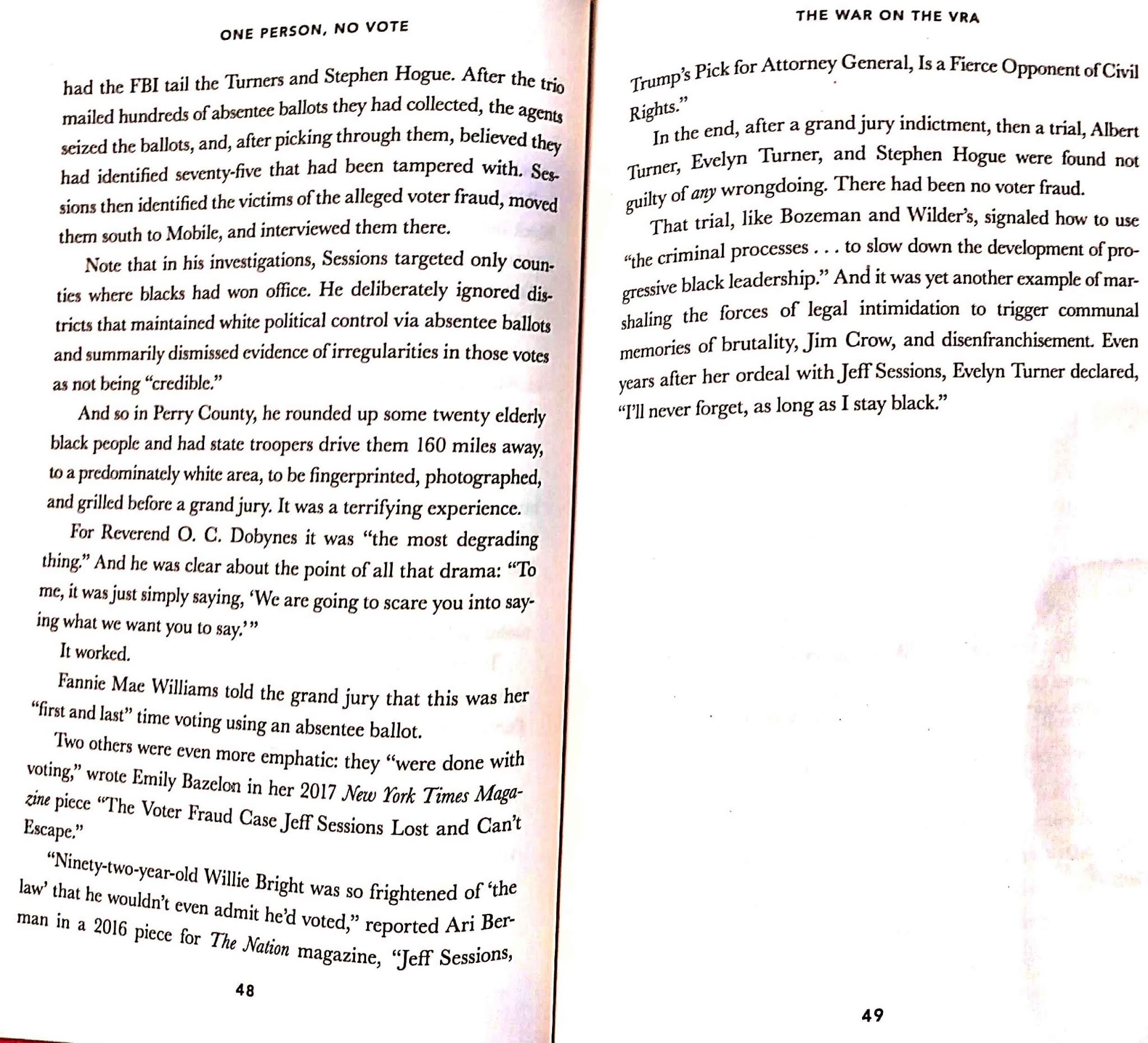
Sometimes as Americans, I think we are culturally egocentric. It makes me sad. I was also surprised (but why) and saddened by how long some of these issues have been stewing and brewing. Current issues are not new! Page 47 brought Jeff Sessions into play in response to the work of Albert Turner Sr. and his wife to help black residents with voting.


Turner went to the Alabama attorney general's office for training sessions and then began to apply that knowledge in Perry and surrounding counties. Not surprisingly, Election Day 1982 brought a very different result. Blacks won positions on the school boards and county commissions.

The Perry County distict attorney cried foul! He was convinced that Turner and company had committed fraud. The DA quickly informed US attorney Jeff Sessions, who hated the VRA, considering it a meddling piece of legislation. 

When the next primary rolled around in 1984, Sessions had the FBI tail the Turners and Stephen Hogue.  (The rest of this is below - pages 48 and 49.)


Page 74 / 75 on the 2000 election in Missouri - "By the time every one of Bond's three hundred plus claims was investigated, it was clear that out of 2.3 million voters in Missouri, the four people who committed some type of malfeasance at the polls hardly constituted rampant voter fraud. And it was also obvious that 'none of these problems could have been resolved by requiring photo ID at the polls.' Yet, from the tattered cloths of bureaucratic snafus, administrative incompetence, and typographical errors, the lie of rampant vote fraud hung there, dangling, as the senator kept fashioning democracy's noose."


FOUR people! Seriously? That time, money, and energy was primarily spent to send a message to black people that they shouldn't vote?


Page 109 . . . "Kemp actually launched a criminal inquiry into the registration of 85,000 new voters, 'many of them minorities,' continued Wines, but 'found problems with only 25 of the registrants.' And here's the kicker. After all the time, money, and publicity, 'no charges were filed.' 

Yet the intimidation was real - too real and too familiar for black folks."


On pages 115-116, the authors relate a story about Kris Kobach as secretary of state in Kansas in 2010. Ugh. It's hard for me to read example after example of how people who are supposed to uphold the law actually use it as a weapon against people they don't respect.


"Once he was elected secretary of state, Kobach's first battle cry was a menacing thrust at the voter fraud that had purportedly engulfed Kansas. As 'Exhibit A,' he pointed to a case where a man named Albert Brewer, who had been dead for years, showed up and voted in the previous primary election. Kobach held up this instance as one of thousands lurking in the voter rolls, skewing elections and canceling out legitimate votes from hardworking, honest Americans. It was vintage Kobach, vintage GOP. It was also not true.

Yes, there was an Albert Brewer who had died. And there was one who voted. But they were not one and the same person. The Albert Brewer who voted - Albert Brewer Jr. - was the son of the man who had died. Kobach hadn't even bothered to check before he started slinging accusations.


Page 141 - "Similarly, the Electoral Integrity Project, based at the University of Sydney in Australia and at Harvard University in the United States, using a number of benchmarks and measurements, was stunned to find that when it applied those same calculations in the United States as it had in Cuba, Indonesia, and Sierra Leone, North Carolina was 'no longer considered to be a fully functioning democracy.' Indeed, if it were an independent nation, North Carolina would rank somewhere between Iran and Venezuela."


This book was hard for me to read and made me kind of sad . . . but I'm glad I read it. My mom was passionate about being involved in the political process. Being informed, voting, helping others to vote. Suppression tactics don't make our democracy stronger.  We should want all eligible voters to cast their vote, even if they don't agree with us. (Hard pill to swallow, but that's what a democracy is supposed to be about!)


Oh! I love that the author ends the book with suggestions to young people on how to be involved in the political process! Page 223 has a list of ways to get involved in your own community: register, help other voters, research, volunteer. Good stuff!


Saturday, April 10, 2021

Eat That Frog! 21 Great Ways to Stop Procrastinating and Get More Done in Less Time

by Brian Tracy

Scott County Library paperback 108 pages (3rd edition)

Published: 2017

Genre: Non-fiction, self help, time management


 I read this book several years ago (10? 15?) and tried to communicate to someone else what it meant to "eat the biggest, ugliest frog" first each day. As gross as the concept sounded, I remembered when I initially read this book, something really clicked for me. So of course, I had to check it out and re-read it.


It didn't resonate for me as much this time around, probably because I'm not as stressed and overwhelmed by the sheer quantity of tasks at work and home. My life has a pace that is manageable and enjoyable. I can still procrastinate at times, though . . . and then I think about which frog I need to eat. The way the author describes it has more to do with job performance. For me, it's the thing that I'm avoiding but know I need to tackle. It helps me to think about what I need to do to just dig in and get started.


I'm so glad that I was able to read this book (in 2021) and think, "this is simply not an issue for me. This isn't what I struggle with or need to spend a lot of time and energy on." Praise God! It was a fun re-read, but I wish I'd blogged about it when I initially read it . . . I think it would be illuminating! This is a fairly quick read and is helpful if you're feeling overwhelmed and in need of a paradigm shift to deal with it all.


(I checked the Excel sheet I used to use to write about books I'd read . . . that goes from September of 2005 Burroughs' Running with Scissors to November of 2007 Friedman's The World Is Flat. No Eat That Frog on there . . . so I must have read it prior to 9/05 or simply omitted writing about it!)